How to Tell If Matcha Is Good (and Spot the Dull, Fake Stuff)
By Jordan, Green Hour Matcha
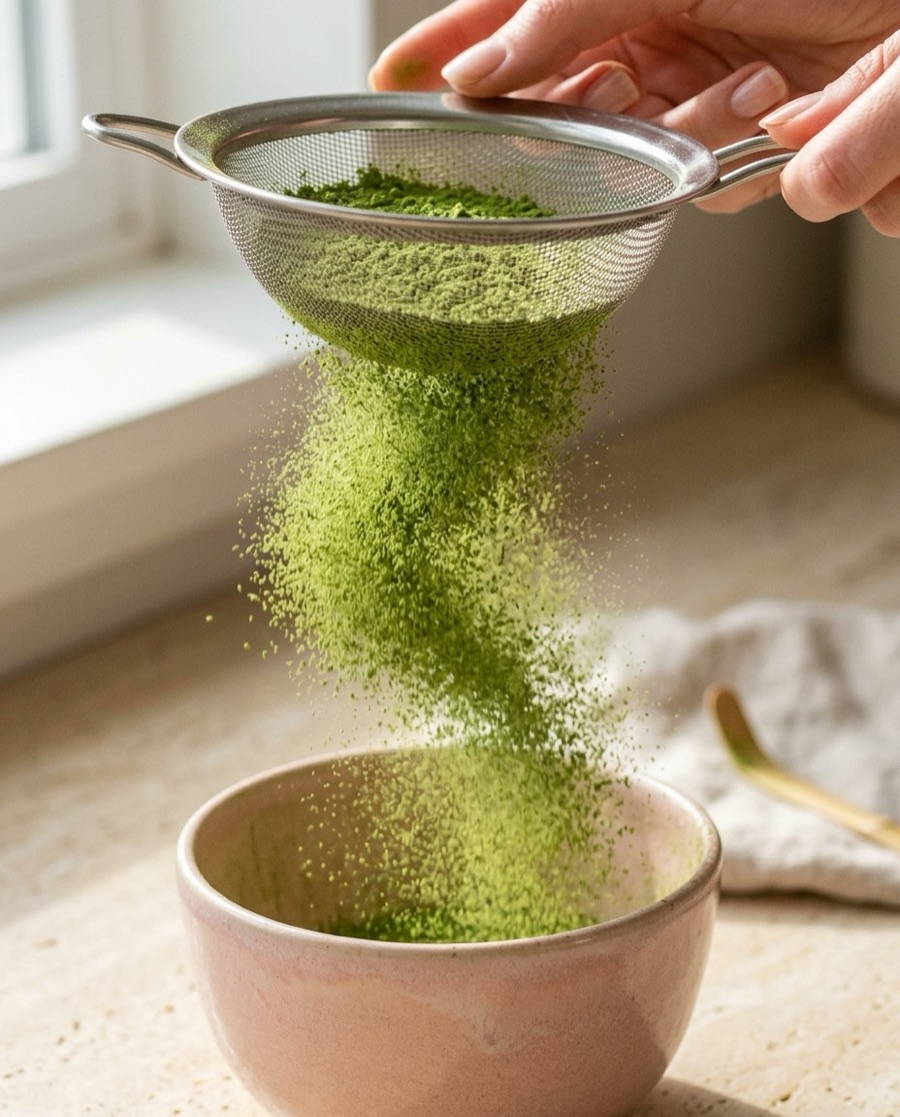
The short version: good matcha is a vivid green, smells fresh and sweet, feels silky between your fingers, and comes with a clear origin and a believable price per gram. Dull yellow-green powder, a smell like hay or dust, a sandy feel and a label that only says "ceremonial" are the warning signs.
You don't need a tasting course. You need daylight, white paper, your nose and a calculator.
The 5-minute check
| Check | Good sign | Warning sign |
|---|---|---|
| Color | Vivid, bright green | Olive, khaki, yellowish or brownish |
| Smell | Fresh, sweet, green | Hay, dust, cardboard, or no smell at all |
| Texture | Silky, like eyeshadow | Sandy or gritty |
| Label | Country, region, one ingredient, dates | Only "ceremonial," no origin, added sugar or powders |
| Price | Makes sense per gram | Far cheaper than everything else on the shelf |
One good sign alone proves little. Four or five together usually do.
1. Color: bright green, not olive
Tip a little powder onto white paper and look at it by a window, not under kitchen lights. Good matcha is a vivid, almost glowing green. The plants are shaded before harvest, which deepens the green, and fresh powder hasn't had time to fade. Air, light and heat slowly turn it olive, then yellowish, then a sad khaki.
Two honest caveats:
- Some good matcha is a deep, dark green. Dark and vivid is fine; dull is the problem.
- Later-harvest matcha, often sold for lattes and baking, is naturally less bright. Different grade, not a fake.
And product photos can be edited: trust the powder in your hand.
2. Smell: fresh and sweet, not hay
Open the tin and breathe in. Fresh matcha smells sweet and green, a little like steamed greens, sometimes with a hint of nori.
Old or low-quality matcha smells flat: hay, dust, cardboard, an old tea bag. Or nothing at all. If you have to hunt for the aroma, the flavor will be hiding too.
3. Texture: silky, not sandy
Rub a pinch between your thumb and finger. Good matcha is ground extremely fine, so it feels silky and clings to your skin, like eyeshadow. Sandy, with visible specks? It was ground coarsely, or it may be a different green tea powder.
What isn't a warning sign: clumps. Very fine powder clumps because of static and a little moisture in the air. Sift it before you whisk, and they're gone.
4. Origin: a country and a region
A good label tells you where the tea was grown, not just where it was packed, and ideally names a region. In Japan, well-known matcha regions include Uji in Kyoto, Nishio in Aichi, Kagoshima, Shizuoka and Yame in Fukuoka.
Matcha is also made in other countries, including China and South Korea, and a country alone isn't a grade. What matters is that the brand knows where its tea grew and tells you. A tin that never says is asking you to guess.
5. The label words that actually mean something
"Matcha" or "powdered green tea"?
Japan's tea industry has a clear labeling standard: matcha is made from tencha, leaves shaded for about two to three weeks before harvest, steamed, dried without rolling, then ground into a fine powder. Green tea ground from other leaves is called powdered green tea. It usually tastes sharper, and outside Japan it's sometimes sold as "matcha."
One ingredient
Plain matcha has one ingredient: green tea. Sugar, milk powder, flavors or the word "blend" mean it's a mix. Mixes can be tasty, but you shouldn't pay plain-matcha prices for sugar.
Harvest
- First harvest (sometimes "first flush"): picked in spring. Usually the sweetest, smoothest and brightest, and the most expensive.
- Second harvest or later: picked in summer. Stronger and more astringent, often used for lattes and baking.
Neither one is fake. They're made for different jobs.
Variety, grinding and dates
Some brands name the plant variety (Okumidori, Samidori, Asahi) or say the tea was stone-ground: signs they know their tea. Most useful of all is a packed-on or best-by date, because matcha loses color and aroma once it's open.
Why "ceremonial" alone means little
"Ceremonial grade" sounds official. It isn't. No legal or industry standard defines it, in Japan or in the US, so any brand can print it on any tin. Some long-established Japanese tea houses don't use the term at all; tea ceremony practice talks about usucha (thin tea) and koicha (thick tea) instead.
So read it as a hint (meant to be drunk, not baked), then run every other check. A tin that says "ceremonial" and nothing else has told you very little.
Price per gram: the number that tells you the most
Divide the price by the grams: a 30 g tin at $24 is 80 cents a gram. Very rough 2026 ranges:
- Under about 25 cents a gram: usually baking-grade matcha in big bags. Great in cookies. A "ceremonial" label at this price deserves questions.
- About 40 cents to $1 a gram: most everyday and latte matcha.
- Over $1 a gram: higher grades, often for drinking straight, usually in 20 to 40 g tins.
The leaf used to make matcha more than doubled in price at Japanese tea auctions between 2024 and 2026. If a price looks too good to be true, it's fair to ask why.
The taste test
Whisk 2 g (1 level teaspoon) with 2 oz of water at 175°F (80°C) and sip it plain, before any milk. Good matcha tastes smooth and a little sweet, with a savory depth called umami and, at most, a light bitterness that fades quickly. Stale or low-quality matcha tastes sharp, drying, flat or dusty, and the bitterness lingers.
One fair warning: water that's too hot makes even good matcha taste harsh, so check the kettle before you blame the powder. Here's why matcha tastes like grass, and every fix.
What we'll tell you about ours
Green Hour matcha isn't on sale yet: we're still confirming our supplier and our price. When it launches, we'll put this whole checklist on the page: where it grew, where it was packed, the grams and the price per gram. Join the list and you'll hear first.
FAQ
What color should good matcha be?
A vivid green, from bright spring green to deep jade. Olive, yellowish or brownish powder is usually old, badly stored or a lower grade. Check it on white paper, in daylight.
Is ceremonial grade matcha always better?
No. "Ceremonial" has no official definition. Judge the color, smell, texture, origin, harvest and price per gram instead.
Does clumpy matcha mean it's bad?
No. Very fine powder clumps easily because of static and humidity. Sift it before you whisk. A sandy, gritty feel is different: that points to a coarse grind.
Is cheap matcha fake?
Not necessarily. Baking-grade matcha is real matcha, made for a different job. The problem is powder sold as something it isn't, like powdered green tea called matcha. The label and the price per gram usually give it away.